
How BMW’s E28 M5 Redefined the High-Performance Sedan
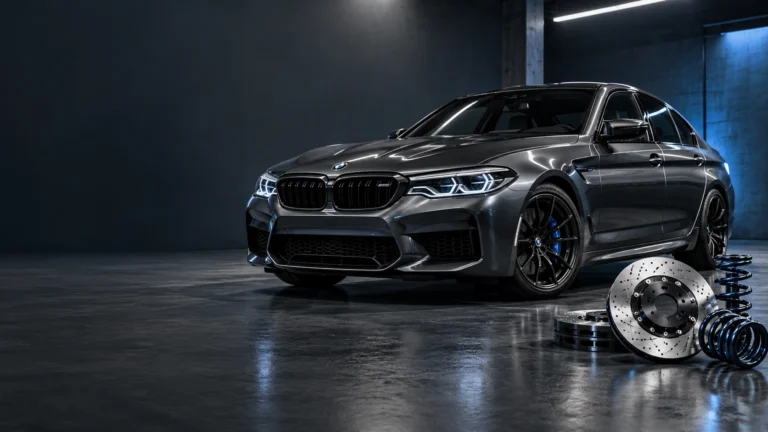
BMW‘s first M5, the E28 generation, quietly launched a new category of high-performance executive cars by pairing a motorsport-derived engine with unassuming four-door styling.
A Discreet Exterior Hiding Serious Hardware
The E28 M5 looked nearly identical to the standard 5 Series, with subtle visual cues limited to a small trunk spoiler, wider wheels, and modest M badging. Under the hood, however, sat a 3.5-liter inline-six derived from the M1 supercar, producing 286 horsepower in European specification and 256 horsepower for North American models.
Production Numbers and Timeline
BMW assembled the E28 M5 between 1985 and 1988, with total production reaching approximately 2,241 units worldwide. The car was initially available only in European markets before a detuned version arrived in North America for the 1988 model year. Each example was hand-built at the BMW Motorsport facility in Garching, Germany.
Performance Benchmarks of Its Era
The European-specification E28 M5 could accelerate from 0 to 60 mph in roughly 6.2 seconds and reach a top speed of 153 mph. Those figures placed it ahead of many dedicated sports cars of the mid-1980s while retaining the practicality of four doors and a full-sized trunk.
- Engine: 3.5-liter inline-six (S38B35)
- Power: 286 hp (Europe) / 256 hp (NA)
- 0-60 mph: 6.2 seconds (Europe)
- Top speed: 153 mph
- Production: 2,241 units, 1985-1988
Impact on the Sports Sedan Segment
The E28 M5 established a template that competitors quickly followed. By blending executive comfort with supercar-level performance, BMW demonstrated that a sedan could serve as both family transport and track-capable machine. This philosophy influenced later models from Mercedes-AMG, Audi’s RS division, and even Japanese manufacturers.
Collector Market and Modern Relevance
Today, well-preserved E28 M5 examples command significant premiums at auction, with values often exceeding six figures for low-mileage original cars. The model’s sleeper status—appearing ordinary yet delivering extraordinary speed—remains a defining characteristic that enthusiasts cite when discussing the M5 lineage.
| Aspect | Details |
|---|---|
| Production years | 1985-1988 |
| Total units | 2,241 |
| Engine | 3.5L inline-six (S38B35) |
| Power output | 286 hp (Europe) / 256 hp (NA) |
| 0-60 mph | 6.2 seconds (Europe) |
| Top speed | 153 mph |
Key Figures
This story includes concrete figures such as 1985-1988 and 2,241. The points below pull out the key numbers so the reporting is easier to scan and verify.
- Production-years: 1985-1988 Assembly of the E28 M5 spanned four model years.
- Total units: 2,241 Worldwide production volume for the first-generation M5.
Why This Matters
The E28 M5 proved that a luxury sedan could deliver supercar-level acceleration without sacrificing practicality, reshaping automakers' approach to performance engineering. Its influence is visible in today's high-output executive sedans and the booming market for modern sleeper cars.
FAQ
Who produced the first M5?
BMW Motorsport, the automaker's high-performance division, hand-built the E28 M5 at its facility in Garching, Germany. The project was led by a team that sought to transplant the M1 supercar's engine into a production sedan.
What made the E28 M5 a sleeper?
Its exterior differed only subtly from a standard 5 Series, with minor additions like a trunk spoiler and wider wheels. Under the hood, however, it housed a 3.5-liter inline-six from the M1, delivering far more performance than its looks suggested.
How many E28 M5s were built?
A total of approximately 2,241 units were produced between 1985 and 1988. European cars received the full 286-horsepower engine, while North American versions were detuned to 256 horsepower.
Why is the E28 M5 historically significant?
It created the template for the modern high-performance executive sedan by combining four-door practicality with supercar-level speed. Its success prompted rivals such as Mercedes-AMG and Audi Sport to develop their own fast sedans.
Sources
- BMW (bmw.com)
- BMW Motorsport (bmw-motorsport.com)
Source: Hagerty